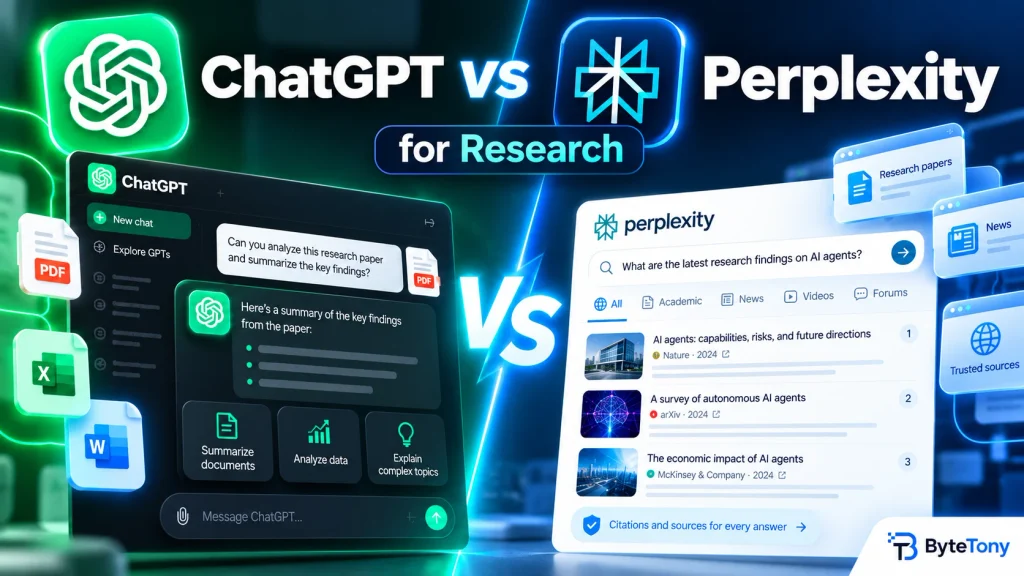
ChatGPT vs Perplexity for Research: which tool is better for finding reliable information? Perplexity focuses on web search and source-backed answers, while ChatGPT combines web research with explaining, analyzing files, and drafting content. The best choice depends on whether you need to find sources quickly or work more deeply with the information.
Note: This article may contain affiliate links. If you buy through them, we may earn a small commission at no extra cost to you.
Table of Contents
ChatGPT vs Perplexity for Research: Quick Comparison
Here’s how the two tools compare on the features that matter most for research.
| Feature | ChatGPT | Perplexity |
|---|---|---|
| Best at | Explaining, analyzing files, drafting | Fast, cited answers and finding sources |
| Web search and citations | Searches when useful or requested; provides citations when searching | Searches the web and provides cited answers |
| Deep research mode | Yes; plan-dependent limits | Yes; 1 Research query/month on Free |
| File/PDF analysis | Yes; limited on Free | Yes; basic, limited uploads on Free |
| Free plan | Yes | Yes |
| Paid plan price | Plus: $20/month | Pro: $20/month or $200/year |
Pricing and feature limits checked in October 2026. They may change over time.
Key Differences for Research
Sources, Citations, and Up-to-Date Information
Perplexity is built around web search and citations, even on its free plan. This makes it convenient for finding information and checking where specific claims came from.
ChatGPT works differently. It can search the web automatically when current information is useful, or you can request a search directly. Search-based answers may include citations, and a Sources button can display relevant links. Without web search, its answers may rely on previously learned information rather than current sources.
You can learn more about this feature in OpenAI’s official ChatGPT Search guide.
For a practical introduction to finding and checking sources, see our Perplexity AI for Beginners guide.
Whichever tool you use, open the original sources before relying on important claims. Citations are helpful, but they don’t guarantee accuracy.
Depth, Analysis, and Turning Research into Content
ChatGPT is useful when your research goes beyond finding information. It can explain complex topics, answer follow-up questions, analyze uploaded PDFs and spreadsheets, and turn findings into outlines or drafts. File uploads and data analysis are available on the free plan with usage limits.
Perplexity often provides concise, source-focused answers, making it convenient for quick facts and research overviews. Its Research mode can also produce detailed reports by examining multiple sources.
Both tools offer deeper research capabilities. Perplexity Free currently includes one Research query per month, while ChatGPT’s deep research availability and usage limits depend on your plan.
For current Perplexity limits, check its official subscription comparison.
My Recommendation
- Choose Perplexity for fast, source-focused research. Its cited answers make it convenient to find and inspect sources, and the free plan includes one Research query per month. It’s a strong free choice when finding sources is your priority.
- Choose ChatGPT for analysis and content creation. Its free plan includes web search, file uploads with limits, and tools for explaining information, organizing ideas, and developing drafts.
Both ChatGPT Plus and Perplexity Pro cost $20/month, but Perplexity Pro also offers a $200 annual subscription.
You can also combine the two. Use Perplexity to find and verify sources, then bring your findings into ChatGPT to summarize, structure, or draft content. Review the output before publishing.
If copied research notes contain extra spaces, repeated blank lines, or unwanted whitespace, ByteTony’s free Text Cleaner can help prepare them for your draft.
FAQ
Is Perplexity more accurate than ChatGPT?
Neither tool is consistently error-free. Accuracy depends on the question, the sources used, and the model. Perplexity makes its sources easy to inspect, but cited information can still be misunderstood or outdated.
Can I use ChatGPT or Perplexity for academic research?
Yes. Both tools can help you explore topics, understand concepts, and find potential references. However, don’t treat their generated answers as academic sources. Verify references in the original papers or databases before citing them.
Conclusion
For ChatGPT vs Perplexity for Research, the better choice depends on your workflow. Choose Perplexity when finding and checking sources is your priority, and ChatGPT when you want help understanding, analyzing, or writing about your findings.
Try the same research question in both free versions, compare their sources and explanations, and see which works better for your needs.
Enjoyed this guide? Support ByteTony and help us create more simple, beginner-friendly tech guides.
☕ Support ByteTony