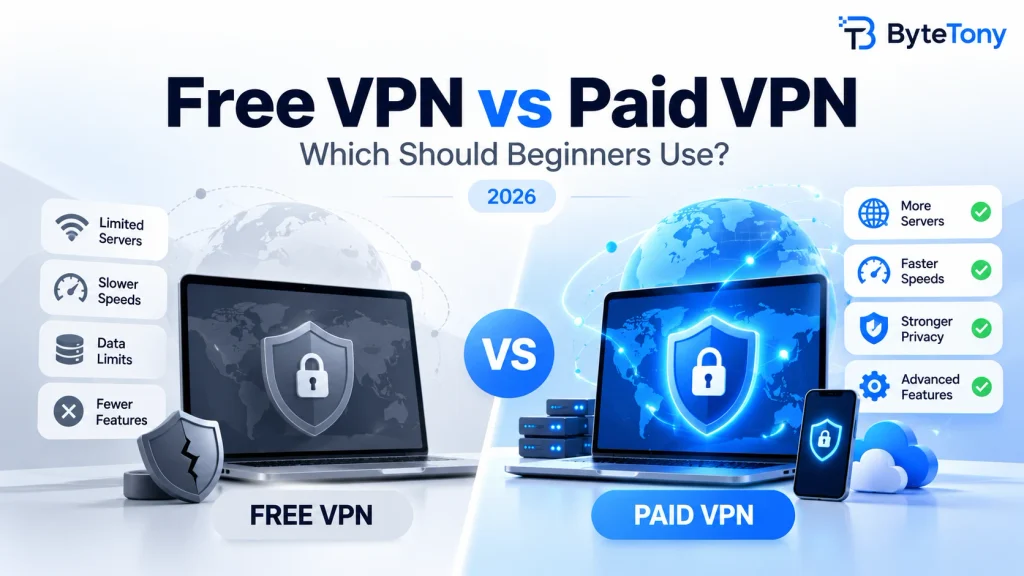
The free VPN vs paid VPN decision comes down to how often you need a VPN and what you use it for. A VPN encrypts your internet traffic between your device and the VPN server and hides your IP address from websites. A reputable free VPN can be enough for everyday browsing, while a paid VPN may be worth it for streaming, travel, or multiple devices.
Affiliate disclosure: This article contains affiliate links. If you purchase through them, ByteTony may earn a commission at no extra cost to you.
Table of Contents
Free VPN vs Paid VPN: Quick Comparison
| Feature | Free VPN (Typical) | Paid VPN (Typical) |
|---|---|---|
| Cost | $0 | Monthly subscription; longer plans often cost less |
| Data limits | Often capped; some offer unlimited data | Usually unlimited |
| Server locations | Limited, sometimes automatically assigned | More countries and selectable servers |
| Speed | May slow down on busy servers | Generally more consistent |
| Privacy | Depends on the provider | Depends on the provider |
| Ads | Varies; reputable free tiers may have none | Usually no in-app ads |
| Streaming | Limited or unreliable | Better streaming support |
| Devices | Often one connection | Usually several simultaneous connections |
Features and prices vary by provider. Check official websites for current details and renewal terms.
The most important difference isn’t simply free versus paid. It’s whether the provider is trustworthy and offers the features you need.
The Real Risk With Free VPNs
Running a VPN costs money. Some free services are supported by paid subscriptions, while others rely on advertising. An unclear business model should raise questions about how your data is handled.
A 2026 academic study of 281 Android VPN apps found that 29 apps leaked user traffic, while 76 transmitted advertising identifiers. These findings highlight why choosing a trustworthy provider matters.
There are two common types of free VPN:
- Freemium services: Providers such as Proton VPN fund their free plans through paying customers.
- Free-only services: Some are legitimate, but unfamiliar providers with unclear privacy policies deserve extra scrutiny.
Before installing a free VPN, check:
- Is the company clearly identified?
- Has its no-logs policy been independently audited?
- How does the service make money?
- Does it collect unnecessary personal information?
- Does it request permissions it doesn’t need?
Remember that a VPN doesn’t replace strong passwords or account security. You can use ByteTony’s free Password Generator to create strong passwords and explore our guide to the best free password managers for beginners to store them safely.
When Is a Free VPN Enough, and When Should You Pay?
A free VPN is usually enough if you:
- Occasionally connect to public Wi-Fi.
- Want additional privacy while browsing.
- Use a VPN on only one device.
- Don’t need servers in specific countries.
Consider paying for a VPN if you:
- Connect every day or use multiple devices.
- Want more reliable streaming or large downloads.
- Travel and need to choose specific server locations.
- Need additional features such as malware or tracker blocking.
For work-related information, always follow your organization’s security policies. A commercial VPN does not replace an approved company VPN or other workplace protections.
Paid VPNs often offer substantial discounts on long-term subscriptions, but renewal prices may be higher. Compare the full subscription cost, not just the advertised monthly equivalent.
Best Free VPN for Beginners: Proton VPN Free
Proton VPN Free is a strong starting point for beginners who don’t need premium features.
According to Proton VPN’s official plan comparison, its free service provides:
- Unlimited data without a fixed speed cap.
- No advertisements or activity logs.
- One simultaneous device connection.
- Access to free servers in 10 countries, with restricted server selection.
- The same core encryption protections as its paid plans.
Actual speeds depend on network conditions and server load. Streaming services aren’t guaranteed to work reliably on the free plan.
Proton VPN has also undergone independent no-logs audits covering its free and paid services.
If you need specific server locations, streaming support, or more devices, a paid VPN becomes more useful.
When Is NordVPN Worth Paying For?
If you’re ready to upgrade, NordVPN is another option worth considering.
NordVPN offers:
- Up to 10 simultaneous device connections.
- Servers across numerous countries.
- Streaming support and unlimited VPN bandwidth.
- A no-logs policy reviewed by independent auditors.
- Additional security features, depending on the subscription plan.
NordVPN has undergone six independent no-logs assessments, according to its official privacy information.
New subscriptions purchased through eligible channels also include a 30-day money-back guarantee, subject to the provider’s refund terms.
NordVPN isn’t necessary for everyone. If Proton VPN Free meets your needs, there’s no reason to pay just for basic VPN protection.
However, if you regularly stream, travel, or protect several devices, NordVPN may offer a more convenient experience.
Compare NordVPN Plans and Pricing
Prices, available features, and renewal terms can change. Review the details before subscribing.
My Recommendation
For beginners, I recommend starting with Proton VPN Free. It provides essential privacy protection without data limits or a subscription.
If you later need more features, compare NordVPN and Proton VPN Plus based on their server locations, device limits, pricing, and privacy practices.
Avoid unfamiliar VPN apps that lack clear ownership, transparent privacy policies, or credible security information.
FAQ
Does a VPN make me anonymous?
No. A VPN masks your IP address and encrypts traffic between your device and the VPN server, but websites can still identify you through accounts, cookies, and browser tracking. Your VPN provider also becomes an important party you must trust.
Is the VPN built into my browser or antivirus good enough?
For occasional browsing, it may be. However, browser-based VPN features often protect only browser traffic and may have usage limits. Antivirus VPNs vary by provider. A full-device VPN app generally protects more traffic, depending on its configuration.
Is using a VPN legal?
VPNs are legal in many countries, but some restrict or regulate their use. Using a VPN doesn’t make illegal activity legal. Check local laws before using one, especially when traveling.
Conclusion
The free VPN vs paid VPN choice isn’t just about price. It’s about finding a trustworthy service that meets your needs.
Start with a reputable free option like Proton VPN Free if you only need basic privacy. If you need more server choices, multiple connections, or reliable streaming, consider a paid provider such as NordVPN.
Whichever service you choose, review its privacy policy, subscription terms, and refund conditions before signing up.
Enjoyed this guide? Support ByteTony and help us create more simple, beginner-friendly tech guides.
☕ Support ByteTony